

Defending Criminal Cases Using Third-Party Culprit Evidence in Massachusetts
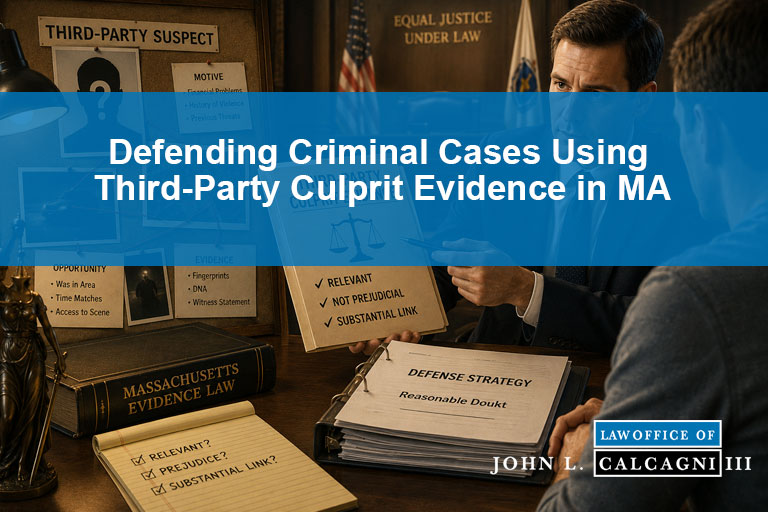
Table of Contents
What Is Third-Party Culprit Evidence?
One possible defense in a criminal case is to cast blame on a third person. This is known as third-party culprit evidence. Under Massachusetts criminal law, evidence that a third-party may have committed the crime(s) charged against a defendant, or that a third-party had the motive, intent, and opportunity to commit the crime(s), may be admissible at trial if the evidence will probably prove a relevant fact in the case. In making this determination, the trial judge must make preliminary findings that the evidence is relevant, will not tend to prejudice or confuse the jury, and there are substantial links between the crime charged and the third-party, or between the crime charged and another crime that could not have been committed by the defendant.
The Admissibility of Hearsay Evidence
It is important to note that hearsay is admissible as third-party culprit evidence. Hearsay is defined as an out-of-court statement, by a person not testifying and subject to cross-exam, offered for the truth of the matter asserted. Hearsay statements that do not qualify as third-party culprit evidence may nonetheless still be admissible at trial for a different, but related purpose, of establishing the inadequacy of the police investigation. For example, information regarding a third-party culprit, whose existence was known to police, but whose potential involvement was not investigated, may be admissible.
Using Third-Party Culpability to Create Reasonable Doubt
There are many circumstances where third-party culprit evidence may be used to defend a criminal case. At trial, the Commonwealth has the burden of proving beyond a reasonable doubt that the defendant is guilty of the crime(s) charges. It is the defense attorney’s responsibility at trial to hold the Commonwealth to this burden, raise potential and applicable defenses, and cast doubt on the issue of guilt. By introducing evidence that the offense may have been committed by another person, who had motive or opportunity, third party culpability becomes a viable defense. In essence, this defense shifts blame away from the defendant and toward others who otherwise may be responsible for committing the crime in question.
The Constitutional Right to Present a Complete Defense
Third-party culprit evidence is a time-honored method of defending criminal cases in Massachusetts. The United States Supreme Court held long ago that state evidentiary rules that bar or limit the introduction of third-party culprit evidence deprive a defendant of the constitutional right to present a complete meaningful defense, as guaranteed by Fifth Amendment due process clause. Simply put, a criminal defendant has a constitutional right to present evidence that another may have committed the crime with which he or she has been accused.
Contact a Massachusetts Criminal Defense Attorney
If you have been charged with a crime in Massachusetts and believe that somebody else may be responsible for committing it, contact Massachusetts Criminal Defense Attorney, John L. Calcagni III, today for a free consultation at (401) 351-5100.