

The Risk Of Sex Offender Registration To Massachusetts Probationers
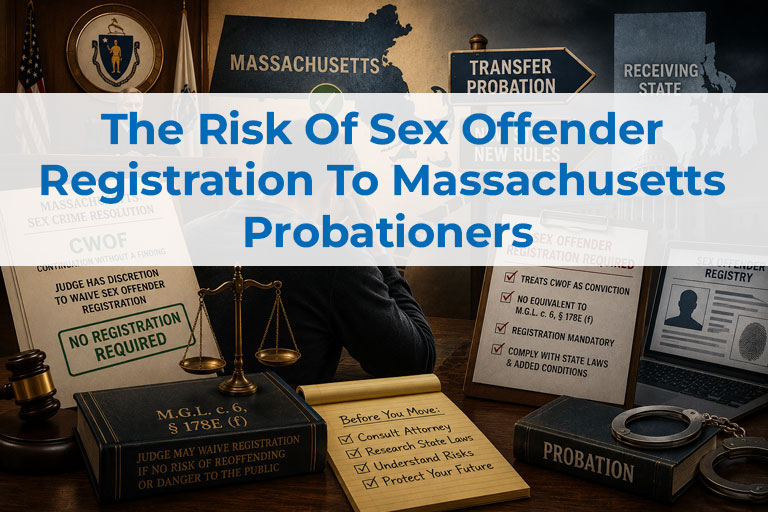
Table of Contents
Sex Crimes and Registration Requirements in Massachusetts
Under Massachusetts criminal law, there are certain sex crimes that require a defendant to register as a sex offender upon conviction. There are also certain sex crimes where a sentencing judge has the discretion to not require a defendant to register.
Examples include Indecent Assault and Battery on a Person Age 14 or Over and Possession of Child Pornography. While Indecent Assault and Battery on a Person Age 14 or Over, generally requires sex offender registration upon conviction, Massachusetts criminal law allows for this crime to be resolved with a continuation without a finding (CWOF). Because a CWOF is not considered a criminal conviction, a sentencing judge has discretion regarding sex offender registration.
When a Judge May Waive Sex Offender Registration
Where applicable, a judge may exercise discretion to not require sex offender registration if a defendant meets certain criteria outlined in M.G.L. c. 6, § 178E (f). The sentencing judge must conduct a hearing, within 14 days of a case being resolved, to determine whether to require sex offender registration. The prosecution most often advocates for registration, whereas where legally possible, the defense opposes sex offender registration. The Court must consider the circumstances of the offense and the defendant’s criminal history to determine if he or she poses either a risk of reoffending or a danger to the public. If the judge concludes the defendant poses no risk of reoffending or danger to the community by the defendant, he or she will be relieved from registering as a sex offender in Massachusetts.
The Risks of Transferring Probation to Another State
A special problem arises when a defendant on probation, who resolved a sex crime in Massachusetts in a manner that relieved him of sex offender registration, elects to live in another state. When this happens, the defendant’s Massachusetts probation is transferred to the state of residence, which is referred to as the receiving state.
When someone transfers probation from one state to another, he or she must comply with the laws of the receiving state, along with any added conditions of probation that the receiving state seeks to impose, which may differ from those conditions imposed by Massachusetts. This includes but is not limited to sex offender registration.
Using the example from paragraph one above, some states treat a CWOF as a criminal conviction, thereby requiring sex offender registration, regardless that registration was not required in Massachusetts. Rhode Island, for example, treats a CWOF as a conviction for sex offender registration purposes, and has no statutory or legal equivalent to M.G.L. c. 6, § 178E (f), to relieve a defendant of the sex offender registration requirement.
Consult an Attorney Before Relocating
If you resolve a sex crime in Massachusetts without having to register, this is considered a victory. To avoid any future defeat, consult with experienced counsel in the receiving state, before you make any final decisions on relocation. If you have been charged with a sex offense in Massachusetts and are at risk of having to register as a sex offender, contact Massachusetts Sex Crime Defense Lawyer, John L. Calcagni III, today for a free consultation at (401) 351-5100.